
After reading Its On You by Nick Chater and George Loewenstein I ended up a bit sad for them. It reads like men who feel they have wasted their lives and are frantically trying to make up for it. They wish they weren’t behavioral economists/psychologists. I might tell them to relax a bit, the academic grass is always greener. I am pretty sure that they haven’t messed up the world as much as they fear and that they wouldn’t have made a noticeably better impact in other disciplines. Want to read academics having a mid-life crisis? I have a book to recommend for you. (I suppose them writing the book is better than buying a gas-guzzling sports car).
The Academic Grass Is Always Greener
The authors worry that “behavioral economics” either a) hasn’t made that much impact, or b) made the world worse by diverting attention from systemic action. It was a bit sad to read given such behavioral work is what the authors have done for a living.
They give a plan for change. This involves moving towards qualitative work which, presumably, they think will help drive systemic change. It seemed a bit strange to believe that would lead to progress. I’m finding it hard to imagine Donald Trump reversing his worse decisions if only we can show him a few more qualitative studies. Could just one more focus group have stopped Trump betraying Ukraine. I guess anything is worth a try.
Academia Already Uses A Diverse Range Of Methods
While many, including me, will cheer the call for diverse methods you get the impression the authors simply weren’t aware that lots of scholars are already doing what they suggest. While behavioral economists tend to use the methods of behavioral economics plenty of scholars already use the alternative methods that they advise adopting. So their systemic change seems a bit of a damp squib.
Broadening the methodological training of graduate students will require coursework that beyond experimental methods to include quasi-experimental, historical, and comparative methods.
Chater and Loewenstein (2026) page 237
I assume they mean broadening the training of behavioral economics graduate students, rather than all graduate students as plenty are already being trained in the methods they suggest be learned. I am not sure why these brilliant behavioral economics students will be able to do amazing things that all the scholars already working with these methods haven’t been able to.
Public Policy Book
In the end this turns into a bit of a public policy book but without the in-depth scholarship on the topics that a public policy scholar might give you. (They get the date of the end of Margaret Thatcher’s premiership wrong on page 185. Many of us have very vivid memories of that). There isn’t much in the way of detail about public policy actions or practical steps that anyone can take now.
George Loewenstein’s economics background really comes through. Let me summarize the approach that they take to public policy. “Now assume we live in a perfect world where you can unilaterally decide to change systems that you see that are flawed, here is our advice on what you should do”.
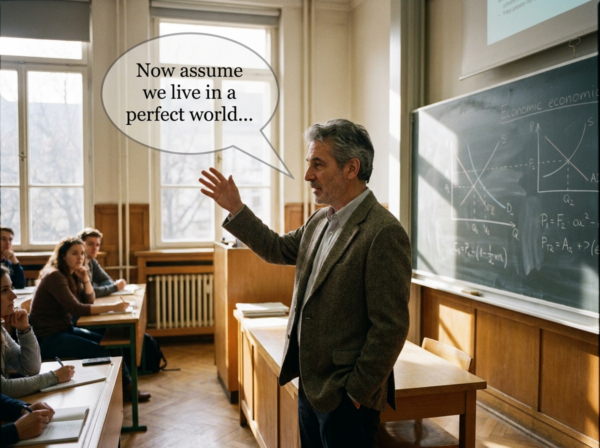
Okay, now imagine that you live in the world that we currently all live in. What should you do? My advice is take, and promote, individual actions while working for systemic change.
Academic Pay And Side Hustles
One of my favorite parts of the book was when the authors showed how out of touch they were with academia. (Despite being academics).
For many academics, and especially those located in business schools or economics departments, salary is a safe but relatively small fraction of their overall remuneration, with much of the remainder coming from industry entanglements.
Chater and Loewenstein (2026) page 65
This seemed like abject nonsense to me. My university salary is the vast bulk of my money — indeed my employment contract stipulates that it must be the bulk. I am not allowed to make vast sums outside my employment contract and I am a full professor at a business school. Maybe I am doing academia wrong and everyone else has massively profitable side gigs so I looked for a citation to check their claims. There was nothing. Maybe the authors have spent too long having doubts about their personal life choices to worry about good evidence.
Get Outside Your Bubble
I can guess how this comes about. Certainly some high profile academics at the most prestigious business schools have lucrative side hustles. (Basically these people are their friends and they obviously don’t interact with mere “normal” academics). But the “many” is doing a lot of work in their sentence about professors’ outside earnings. Their claim surely can’t be true of the vast majority of academics. Maybe the real money might be in consulting at some UK business schools and the odd person in the Ivy league but not for those at state schools, those at teaching schools, or those in precarious positions in academia. Through their nonsense, the authors risk perpetuating the sort of hostility to academia that gets us into the position where policy advice from academics is rejected because the voters and politicians believe academics are all on the take.
Reading the book you might think many academics are simply bought. I’m not and I don’t think the vast majority of academics are bought. (I’m not claiming to be especially virtuous, I don’t think I’m influential enough for someone to try and buy me).
For more on public policy see Experts Need To Take Public Policy Interventions Seriously, Improving Public Policy Through Testing, and Public Policy, Behavioral Economics and Marketing
Read: Nick Chater and George Loewenstein (2026) It’s on You: How Corporations and Behavioral Scientists Have Convinced Us That We’re to Blame for Society’s Deepest Problems, Venture
