I must confess to finding discussions around degrowth fascinating. I’m not a fan of degrowth. It seems a bit of a slippery term with defenders saying it isn’t about shrinking the economy despite “degrowth” sounding like it means that. Still, it is always interesting to see what others are saying. A group of scholars led by Dario Krpan surveyed the US and UK publics on their reactions to elements of the degrowth platform and terms used to describe it. Does degrowth by any other name smell as sweet?
What Is Degrowth?
A real challenge is understanding what terms mean. This is a recurring problem in a lot of discussion and it is central to this research. Terms generate a whole host of disparate reactions in different people which hinders discussions. Degrowth, to many, conjures up the idea of shrinking the economy to benefit the planet but the authors see it differently and give their summary of the idea.
Degrowth—the notion that high-income economies
Krpan and colleagues (2025) page 1
should reduce non-essential production while prioritising wellbeing….
They note that critics argue that the term degrowth isn’t popular with the public. They suggest that there is no convincing evidence that the term is hindering support. This seems to contradict what I find in informal surveys but I don’t have reliable data. So is the term degrowth and/or the platform of degrowth unpopular? The authors seek to examine whether this is the case.
The Full Degrowth Proposal
They outline the “full degrowth proposal” that they assessed the popularity of. It isn’t short. Many of their survey respondents had to read this full platform and so checks were necessary to ensure that respondents were concentrating sufficiently. This is not something that we do for voters which does make their test somewhat artificial.
The platform they tested was:
- “That high-income countries would scale down harmful and non-essential production and consumption to help achieve ecological goals;
- “That wellbeing would be improved by ensuring universal access to public services, affordable housing, gainful employment, and living wages;
- “That control over the economy (production, resource use, and public services) would be progressively democratised;
- “That countries in the Global South (i.e., the developing economies of Latin America, Africa, the Middle East, and Asia) would be liberated from patterns of appropriation and enabled to achieve human development;
- “And that improvements in technological efficiency would be pursued alongside sufficiency principles” (page 3)
Word Choice Matters In Surveys
One challenge with surveys is that word choice matters. Their platform is light on actual actions to be taken. More specific language that outlined what was going to be scaled down, e.g., flights, might or might not be as positive. Reasonable questions might be asked about how democratization of the economy would be undertaken etc… They seemed to be rigging the results a bit in their choice of wording. I wondered who would disagree with some elements. For example who would say they are for “harmful and non-essential production and consumption”. Still, what do they mean by non-essential and who gets to tell you what you want is non-essential?
Putting aside those concerns, their survey suggests that this platform is relatively popular with the public. It is interesting that the public seemed keener than one might imagine.
To test whether my hunches about degrowth being less popular than they found were widely held, I asked Claude whether degrowth was popular with the US and UK public. It gave me the stats from this paper. Obviously, this wasn’t that helpful at broadening my view given I had just read the paper but at least it shows that their paper has made an impact. We probably should have that as a new metric for promotion and tenure decisions. Does Claude know who you are?
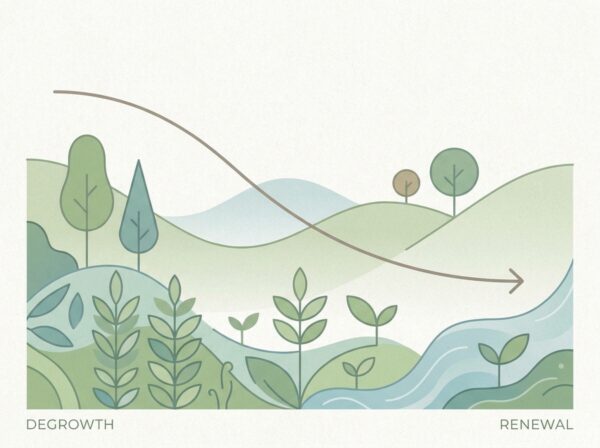
Does Degrowth By Any Other Name Smell As Sweet?
Another consideration they looked at was whether labels, including degrowth, well-being economy and eco-socialism, were popular.
When confronted by the label, degrowth alone, the public aren’t at all keen. Yet, when more details of the full program are shared the idea becomes much more popular. The authors suggest that the label doesn’t drag down the degrowth platform, if the idea is fully explained. I must confess that I thought the label would be more of a drag even after they included the full explanation.
I did still wonder about the use of the label, degrowth, as I don’t think the survey puts to rest all concerns. Effective labels should win support from people who just hear the label without hearing any more details. If you need to people to concentrate fully for many minutes to hear your full proposal before the label becomes popular maybe it still isn’t a great label?
For more on Degrowth see An Ineffective Defense Of Degrowth, Limits And Self-Limits, and Messaging About Sustainability, Are We Making Any Progress On Sustainability?, Working In the Doughnut, and Growth Can Come From Climate Action
Read: Dario Krpan, Frédéric Basso, Jason E. Hickel, and Giorgos Kallis. “Assessing public support for degrowth: survey-based experimental and predictive studies.” The lancet planetary health 9, no. 11 (2025).
