
I was reading a book on teaching the other day and it occurred to me that teaching is marketing. Many of the same things that make for a great teacher are also what make for a great marketer.
Teaching Matters (Or At Least It Should Do)
A peculiarity of being a professor at a research university is that outsiders often have no idea what you do most of the time. There is a widely held belief that professors spend their time teaching inquiring young minds. Yet, a lot of what of the best research professors do is to try and avoid teaching. If you get really, really good at research you might even get a gig where you can avoid pretty much all students. Maybe you have some PhD students but they are a very different challenge than hoards of undegrads.
Yes, research does matter but I think a lot of our profession have got a bit over-excited about the contribution of their research to the world. I’m not saying that a select few researchers don’t make a big difference, e.g., curing cancer, but most professors have a less dramatic impact. Not saying most of our research never has a positive impact — just not an earth shattering one. Our teaching is often what may have the most positive impact upon the world. Yet, rather hilariously, most professors I have met have had no meaningful teacher training.
Given teaching matters, and we aren’t trained to do it, it is important to do one’s best to learn a bit about teaching. The good news for marketers is that much of what we learn in marketing applies because teaching is marketing.
Teaching Is Marketing
Obviously, there are differences between commercial marketing and teaching. We aren’t allowed to ask the students for money directly. (It might be pretty humbling if the students decided how much they wanted to pay for each of our courses). That said, a lot of principles are the same.
I am not making a simplistic argument that universities should be run on commercial principles. My view of marketing is much wider, so not-for-profits, governmental entities, and even ideas can and should be marketed. Marketing, in my meaning at least, is a generally good thing.
Marketing is about serving the needs of the customer, while teaching is about serving the needs of the students. To do this you need to understand the customers or students.
Heterogeneity
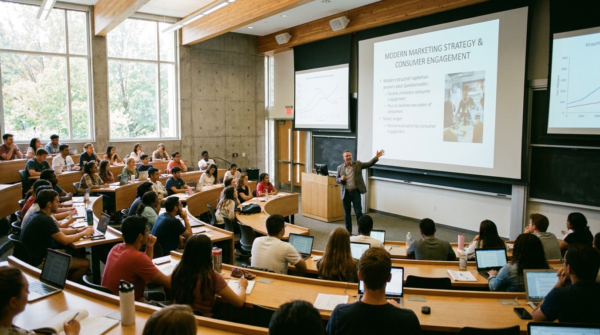
One of the classic problems in commercial/public sector marketing is mirrored in teaching. Heterogeneity is the fancy word for saying people differ. This really matters to how you teach and also how you market a commercial product or how you provide a governmental service. Indeed, that students differ is the first principle to address in Lovett and colleagues view of smart teaching.
Students differ from each other on multiple dimensions — for example, in their identities, stages of development, and personal histories — and these differences influence how they experience the world, and in turn, their learning and performance.
Lovett et al., 2023, page 3
So you need to try and understand your students but they all differ. It is really hard to understand them all and tailor to each needs. That said, you have to give it a go.
Other Nuggets
A couple of other nuggets from the book are worth noting.
The Curse of Knowledge is alive and well in academia. The basic problem is that when you know a lot it is really hard to comprehend that others don’t also know it. Professors should, hopefully, know a lot about their subjects so they must pay special attention to any assumptions they make about the knowledge of their students. Starting ahead of where the students are is a major problem for teachers.
The authors also tackle the idea of different learning styles, e.g., people who are visual learners. They aren’t impressed with the research backing behind the idea of these styles. Apparently, people got over-excited with these ideas despite not much in the way of credible research support. That is just as well, it is hard enough to get to understand our students without this random extra dimension to worry about.
For more on teaching see Bribery works with students, Teaching About Climate Change, Hopeful Teaching About Climate Change, Education Technology–The Blackboard, and Do Computers Distract Us? Of Course They Do
Read: Marsha C. Lovett, Michael W. Bridges, Michele DiPietro, Susan A. Ambrose, Marie K. Norman (2023) How Learning Works: Eight Research-Based Principles for Smart Teaching, 2nd Edition, Joseey-Bass