
Nick Chater and George Loewenstein’s book, It’s On You, looks at how attempts to drive attention to the actions of individuals diverts attention from the need to change systems. Strangely, although I suspect I agree with the authors on a lot of what they say about the need to change systems, I was disappointed after reading the book. I was hoping that they would detail evidence how individual actions crowd out systemic change in a variety of markets. The evidence they offered was quite sparse. Indeed, I was left wondering: is systemic versus individual a false dichotomy?
More Evidence Of Action Than Impact
The core of their argument seems to be that corporations often try and push responsibility onto consumers. This definitely happens.
They point to a lot of behavioral research that seeks to influence individuals and say it often doesn’t work. Seems true too.
They suggest that together these stop systemic action. That seems a bit of a leap. Their suggestion seems to be that if Richard Thaler and Cass Sunstein hadn’t published Nudge we’d have much better governmental systems. A weak argument to my mind.
Climate Hypocrites
They can seem a bit divorced from reality. The authors argue that people shouldn’t link climate activists with their carbon footprints. After all the single advocate, even if they have a relatively large carbon footprint, doesn’t make a noticeably impression on the overall numbers. They seem to blame those hostile to the climate action for weaponizing the poor behavior of activists.
Linking climate advocates with their carbon footprints uses an individualistic focus to discredit those advocating for systemic reforms, branding them climate hypocrites — a powerful tactic”
Chater and Loewenstein (2026) page 42
Yes, it is a powerful tactic. It is a powerful tactic because it makes total sense. If an individual claims they believe in something and acts otherwise they are a hypocrite and/or a liar. People should rightly ignore them. If climate activist’s bad behavior undermines climate action it is the fault of the climate advocate not the person criticizing the hypocrisy.
Of course, if the critic’s claims are untrue or completely unrealistic — climate activists must still travel places and they do need to eat — that is wrong. Still, a climate activist who is a total hypocrite should be pilloried. Pass me the rotten tomatoes.
Is Systemic Versus Individual A False Dichotomy?
As I said, I agree with the authors on a lot of their public policy points.
- We need to fix US healthcare.
- Money is not speech, the wealthy shouldn’t be able to buy elections.
- You shouldn’t need to be a financial expert to end up with a decent pension.
Systemic change is desparately needed.
That said, the author’s core argument didn’t work for me. As I’m not sure how the focus on the individual action necessarily detracts from the possibility of system change.
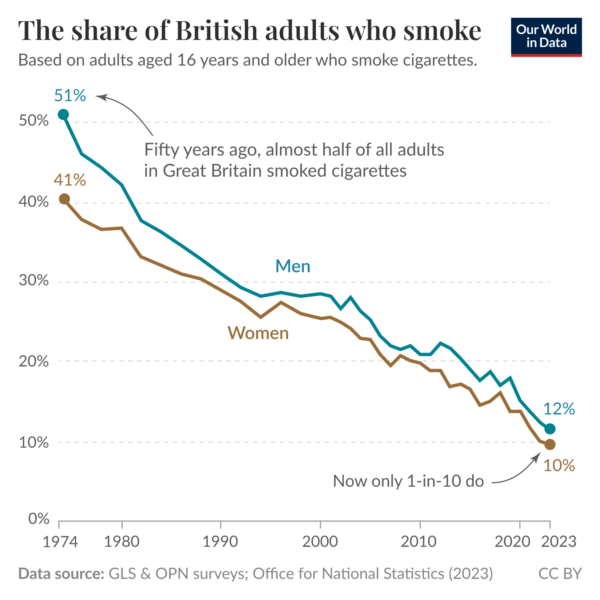
Consider the case of smoking. Here individual actions and systemic change have worked together to drive down rates. Taxes (systemic change) helped individuals use their will power to give up. When fewer people were smoking this allowed the possibility of more systemic change.
Consider a vital piece of systemic change that the authors note; banning smoking in public places. I’m sure they are correct that this ban (a systemic change) has helped accentuate the decline of smoking. But could it really have happened if a lot of individuals hadn’t already stopped smoking? The collapse of smoking rates allowed the UK to ban smoking in public places in 2007. Yes, the law change mattered a lot, but would that law ever have been passed if over half of men were still smoking as they did in the 1970s? I’d guess the smokers would never have accepted the ban and their attempts at vetoing the law would have been more successful when there were more of them.
Individual Action Isn’t A Diversion
They, I think rightly, say if you could do any one thing that the ideal way to deal with climate change in a perfect world isn’t for individuals to take specific actions, e.g., buying EVs, but for there to be a carbon tax. That sounds great. Still, I can’t personally implement a carbon tax. I can buy an EV though.
They point to the Canadian carbon tax as an example. That implementation was far from perfect because individuals weren’t won over. It helped Justin Trudeau lose his job as Prime Minister and Mark Carney, his successor who had a long and admirable history on climate action up to that point, dialed it back. Yes there was a lot of terrible mis-information which undermined the policy. Still, part of why the attempted systemic change was vulnerable was that individual change hadn’t got far enough.
Want to implement higher gas taxes? My advice, if the public can be persuaded to buy EVs and it’ll be so much easier.
For more on Nudging see A Taxonomy Of Nudging, Nudging: Calm Down It Really Is Not The End Of Freedom, Nudges Are Not Magical (Just in Case Someone Thought They Were) and Who Doesn’t Want Nudges And Competent Government?
Read: Nick Chater and George Loewenstein (2026) It’s on You: How Corporations and Behavioral Scientists Have Convinced Us That We’re to Blame for Society’s Deepest Problems, Venture