
Mike Colias’ book, Inevitable, tracks the rise of EVs (electric vehicles). Unsurprisingly given the title his theme is very much, the inevitable transition to EVs. In the US, you could be forgiven for thinking that EVs are in trouble, but that requires thinking that a clearly superior technology, which is only getting better, will fail to displace an inferior polluting tech. Some like to think that the world will stay still but it really won’t. I look forward to a day when only weirdos have gas cars. That day probably isn’t that long away.
People Don’t Like Changing When They Are Good At Something
Relying on traditional automakers in the US to lead the transition to EVs is a problem. Colias spends a lot of time noting how the engineering centric thinking of the big US automakers has led them to develop better and better versions of the ICEs. They have been doing that for a while and have wrung a lot, an impressive amount really, of improvement out of gas vehicles. Unfortunately, they simply aren’t as good at new stuff like EVs. They are clearly tempted to try and continue what they are doing and hope that the world doesn’t change.
Similarly, auto-dealers know how to sell gas vehicles, and they don’t know much about EVs. (Some also decided on political grounds that EVs weren’t their thing). Dealers profit from the higher levels of service needed by gas cars given that service often happens in their shops and dealers rely on those margins.
The transition to electric vehicles is threatening to finally force major changes in the dealership business model. For starters, it’s expected to put a big dent in the dealers’ service business.
Colias, 2025, page 195
Like the manufacturers, dealers have been hoping, “couldn’t things just stay the same?” Many dealers aren’t even really trying to sell EVs in the US. They certainly were trying to discourage me when I bought my EV a couple of years back. It’s a tough thing to admit but Elon Musk knew what he was doing. Musk went around dealers to establish Tesla’s sales channels.
The Tide And The Inevitable Transition To EVs
This hope for a return to the golden age of gas guzzlers has been reinforced by the US’s habit of finding the oldest possible person alive to be president. Joe Biden loved classic US cars with a nostalgia that doesn’t work for anyone under 70. (To show how much he loved his classic cars didn’t Biden share secret documents with his Corvette?) Joe Biden clearly wanted to protect the car companies so they could all reenact the 1960s when he was a dashing young man (and obviously before Hunter was born when Joe could be proud of his achievements).
Donald Trump has his own peculiarities. He loves tariffs even more than Joe Biden. (I honestly didn’t think that was possible for someone alive in the twenty first century). Trumps’ belief that oil is the future is surely one only someone about to reach 4 score years could maintain with a straight face.
Maybe Trump isn’t as out-of-touch as he seems. There is the famous story of King Cnut (of Denmark and England) who futilely commanded the tide to stop coming in. Cnut is often portrayed as a fool, but the counter-story is that he commanded the tides seemingly out of modesty to demonstrate the limits of his regal power. Maybe Donald Trump is very secretly a deeply modest man who is determined to embrace largely futile anti-EVs policies simply to demonstrate the limits of his own power. I guess anything is possible.
Different Approaches Seem More Successful
But not all countries have been determined to preserve the good old days. China never had a strong auto industry and could pivot to a new type of vehicle without as much baggage. Chinese battery makers got into making vehicles, seeing EVs as expensive batteries with a few wheels attached. Of course, China threw major subsidies at its EV industry but, even acknowledging that, it is hard to imagine the US (or Europe) making such rapid strides in EVs. The great history of car making in the US and Europe likely slowed change.
The new strategy was compelling for China, which could get away from foreign oil. From their perspective this makes sense especially as the US is working on controlling — is that the same as stealing? — Venezuelan oil to sell to them. With EVs, China could leverage their battery skills and tackle air pollution in their cities. People often seem to forget that it isn’t just greenhouse gases that gas vehicles produce. Air pollution from gas powered vehicles is a killer and, even if it doesn’t kill you, who loves breathing in the fumes?
The logic of China moving to EVs was clear.
Bypassing internal combustion engines for electrics could not only help China catch its bigger rivals in the auto industry but surpass them.
Colias, 2025, page 57
US Gave China The Opportunity, Don’t Repeat The Mistake
The US had plenty of opportunity to beat China at EVs. Colias shares challenges with EVs from 1900 that held electric vehicles back then which are still eerily reminiscent to concerns now. One hundred and twenty-six years is a long time. If US automakers had focused on EVs then, I’m sure we could have solved the challenges that remain by now. But even more recently the US wasn’t properly committing to EVs. In the 1990s GM even launched an electric vehicle, the EV1. It wasn’t perfect but it was a great start.
In what some now see as an epic misstep GM walked away from the [EV1] project, deciding it was too big a financial drain.
Colias, 2025, page 25
The US has largely ceded the EV market to China while the best US EV manufacturer, Tesla, seems to be actively working on destroying its brand with the sort of people who buy EVs. (A quirky business choice). The US can still be a force in the EV market; trying would surely beat hoping that things will stay the same which simply isn’t a cogent strategy.
EVs Are Inevitable
The logic of moving to electric vehicles is clear worldwide. Prices are falling, batteries rapidly improving, and access to charging rising. (That is without factoring in whatever Trump is doing with Iran). When sufficient momentum is gained markets will likely tip fast. Norway is showing the way, with 96% of new cars being EVs. Once people see the benefits for EVs there seems little reason to go back.
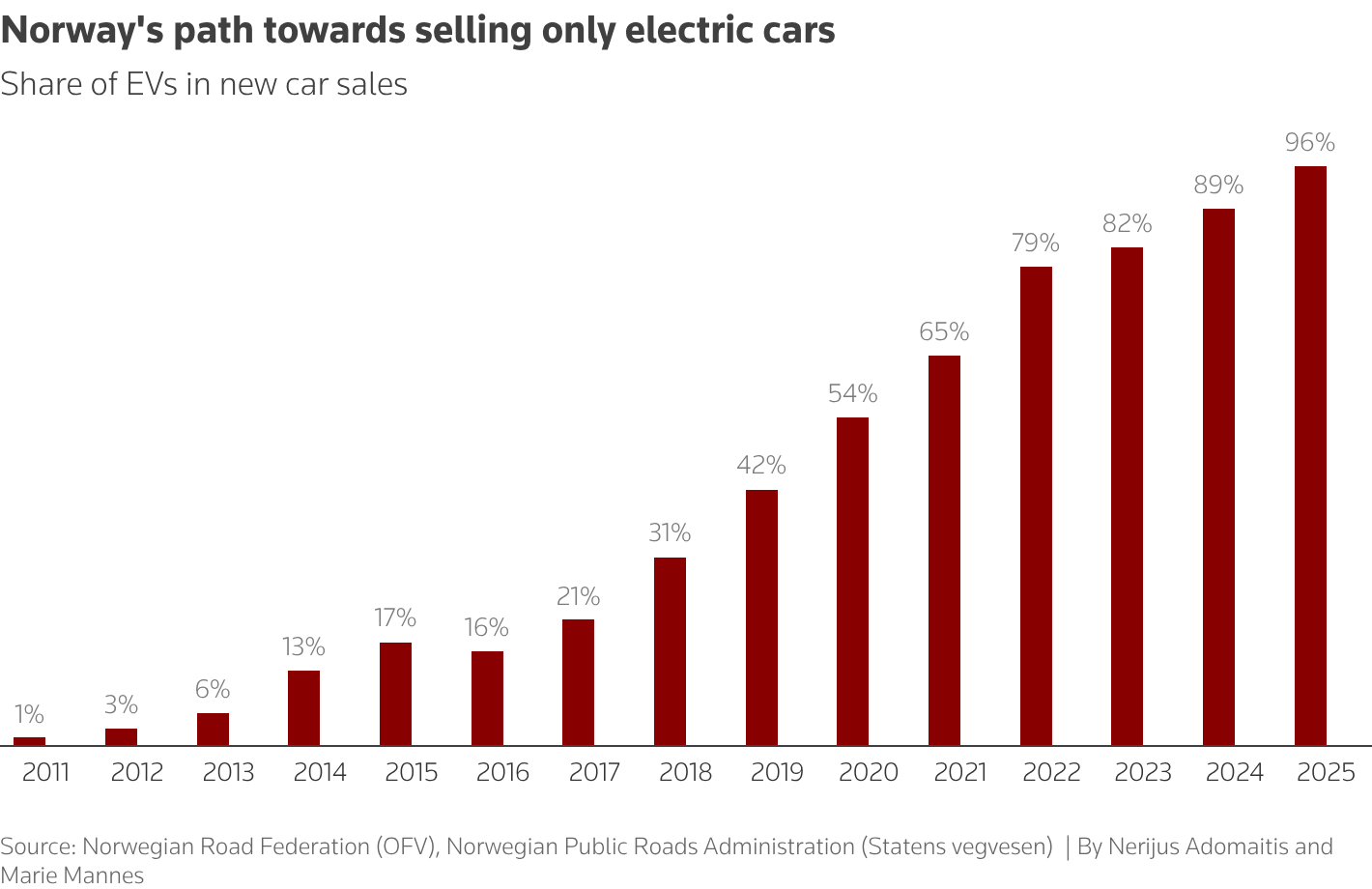
The world will be a better place if EVs displace gas vehicles. I am confident that they will. Only secondary questions remain such as:
- a) whether other countries than China make a significant impact on the market? And
- b) when will the inevitable transition to EVs happen in the US?
For more relevant to EVs see Are We Making Any Progress On Sustainability? and Information Is Key To Recognizing Progress
Read: Mike Colias (2025) Inevitable: Inside the Messy, Unstoppable Transition to Electric Vehicles, Harvard Business Press