
The world is a complex place. Countries all have their own histories, and these have intersected in the past creating some positive and other, often more noticeable, negative interactions. These feed into modern discussions. People in richer countries forget that it wasn’t always the way it is now. Sometimes they romanticize poverty in a way that poorer people don’t. When we talk development and sustainability a challenge is that many of the things that made wealthier countries richer in the past are precisely the sort of things that we want to discourage. Now there are better ways of developing, but we should never blame people for wanting the opportunities that other people have.
Sweden Changed For The Better
It is easy when living in a relatively rich country to think it was always that way. The UK, where I grew up, got rich early relative to other countries but that was only a few centuries ago. Even British wealth in the days when it was the most powerful country in the world was nothing compared to British wealth nowadays when it certainly isn’t. Fancy going back to the days without indoor plumbing? I don’t. I find small black and white televisions scary.
Hans Rosling’s biography, How I learned to understand the world, helps to explain where his positive view of the world arises from. The Swedish doctor came from a relatively humble family. They were poor and lived in substandard accommodation. Indeed, he almost died as a child drowning in an open sewer. But Sweden was getting richer, it was forming a strong welfare state and introduced universal healthcare. The process of improvement for the people was clear to Hans Rosling even in his lifetime and the previous generations of his family’s understanding was even stronger.
[Grandma Berta’s] praise of electricity was unstinting
Rosling, 2020, page 6
If there is one thing we should take from history, it is when you don’t have a proper toilet or healthcare or electricity getting them makes an amazing difference.
(Nearly) All People Want Access To Useful Things
Rosling spent notable periods of his life working amongst people who didn’t have the things that he took for granted.
I remembered only too well how much people in poor parts of the world desired electricity, running water, roads, and access to education and healthcare.
Rosling, 2020, page 170
Looking from the outside practicality can be a minor point. We can sometimes fall for the romance of poverty, feeling it is purer or more natural. Even Rosling at times found himself doing so.
Tin Roofs Are Wonderful
“Still, the straw roofs were surely prettier? Do you really prefer tin?”
Rosling, 2020, page 35
The answer: the straw roofs were a nightmare. Tin certainly wasn’t elegant, it is a pretty ugly choice to be honest, but people wanted tin roofs because they were better for them. When the people got rich enough to upgrade to something better than tin then they would, but no one wanted to go back to straw.
As you observe societies in transition, it is easy to focus on the ugliness. But the people I spoke to in Nepal knew where they were going and they were happy to be on the journey.
Rosling, 2020, page 37
Progress is a good thing. If you love the purity of living without modern amenities good for you. But we need to ensure everyone in the world has the option not to have to put up with a lack of amenities.
Total Emissions Don’t Make Sense When Judging Responsibility
A challenge in sustainability it that getting richer has traditionally been associated with environmental destruction. You can certainly see people in richer countries worrying about the poor becoming wealthier. Shittier people even think we should try and keep people poor to save the world.
Over the years, I had become horrified at the way blame for causing climate change had been systematically heaped on India and China. The basis has been their total emissions, even though both countries have much larger populations than other countries. I had always thought it was a silly argument, analogous to stating that obesity was a more serious issue in China than in the US because China’s total body mass was the bigger of the two.
Rosling, 2020, page 187
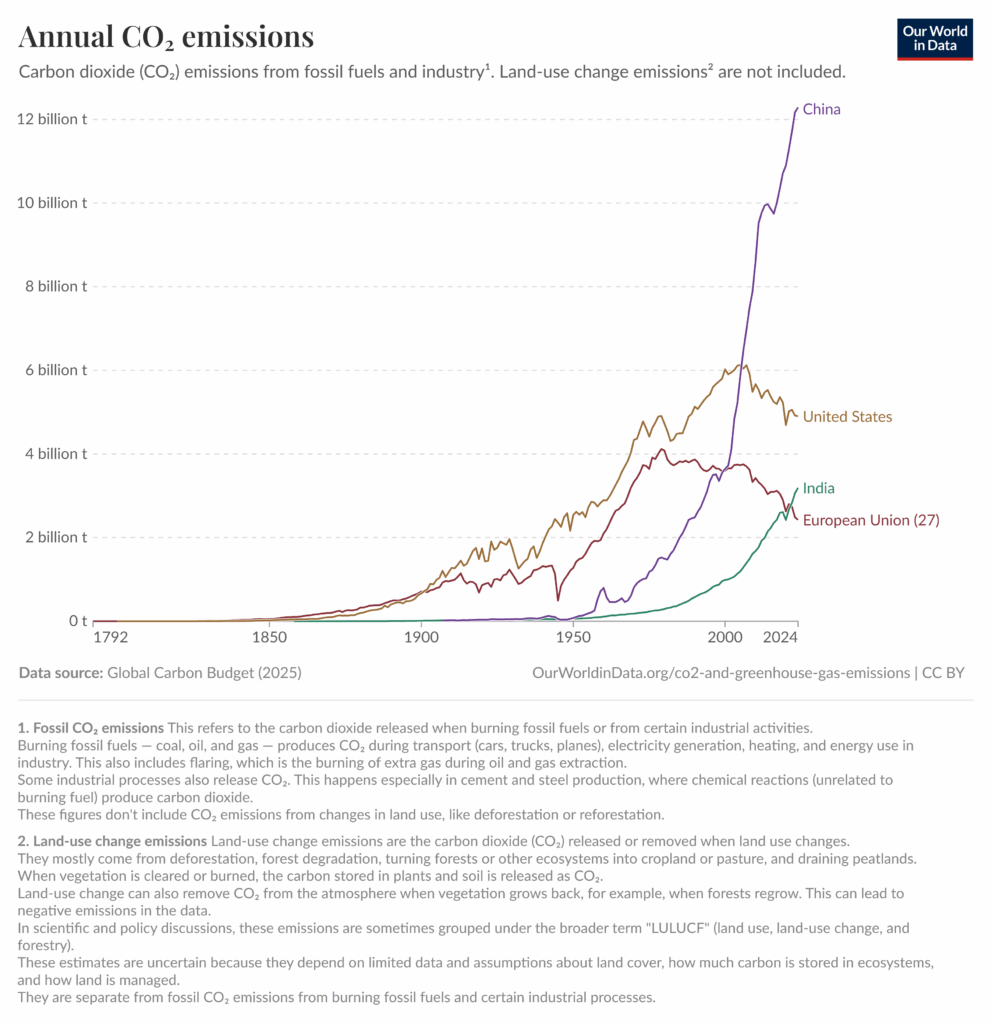

There are many reasons to worry about China’s impact on the world, but it is currently hard to blame that country for not doing more on climate change when you live in the US. I think our current federal policy is that ‘science is for nerds’. Federal advice seems to be that real men should eat raw meat, be scared of anyone who doesn’t look like them, and lick the boots of more powerful men.
Getting back to the emissions, what can’t be argued is that it is silly to expect emissions from populous counties to be the same in total as smaller countries.
Development And Sustainability
We need people who don’t have what they need to get it. This will be hard. How to achieve this without destroying the world? These are big problems; I would say these are Wicked but I’m afraid someone will start to sing.
There is a lot to do to make the world better. That sheer scale of the challenges can seem daunting. At least one good part of that is that it means you don’t need to worry about finding something positive to do. There are plenty of opportunities for improvement.
Rosling was at his heart optimistic. With hard work people across the world had helped make the world so much better in his lifetime but there was an awful lot more to do. He didn’t think it was time to give up. As the journalist who helped finish his memoir quoted hm.
Its never too late to give in, so we might as well do it some other time
Rosling, 2020, page 242
For more on Hans Rosling see A Positive View Of The World Using Facts and Improving How We See The World. And for how one country, Ireland, has improved in recent generations see Change For The Better.
For exactly what sustainability needs to get away from see Population As A Disaster and What If I’m Wrong?
Read: Hans Rosling (2020) How I learned to understand the world: a memoir. Flatiron Books, 2020.