
Why Your Performance Metrics Might Be Measuring the Wrong Thing
We have a problem in business. We talk about purpose, stakeholder value, and long-term thinking—but when it comes to measuring success, we default to the same old financial metrics. It’s like saying you care about health while only ever stepping on a scale.
The issue isn’t that financial metrics are wrong. It’s that we’re using a one-size-fits-all approach to measure fundamentally different types of businesses with fundamentally different goals.
The 4Rs Framework
In our recent paper, Jonathan Knowles and I propose four distinct standards for measuring business performance—what we call the 4Rs. Each represents a different view of what business success actually means, and each requires different metrics to measure it properly.
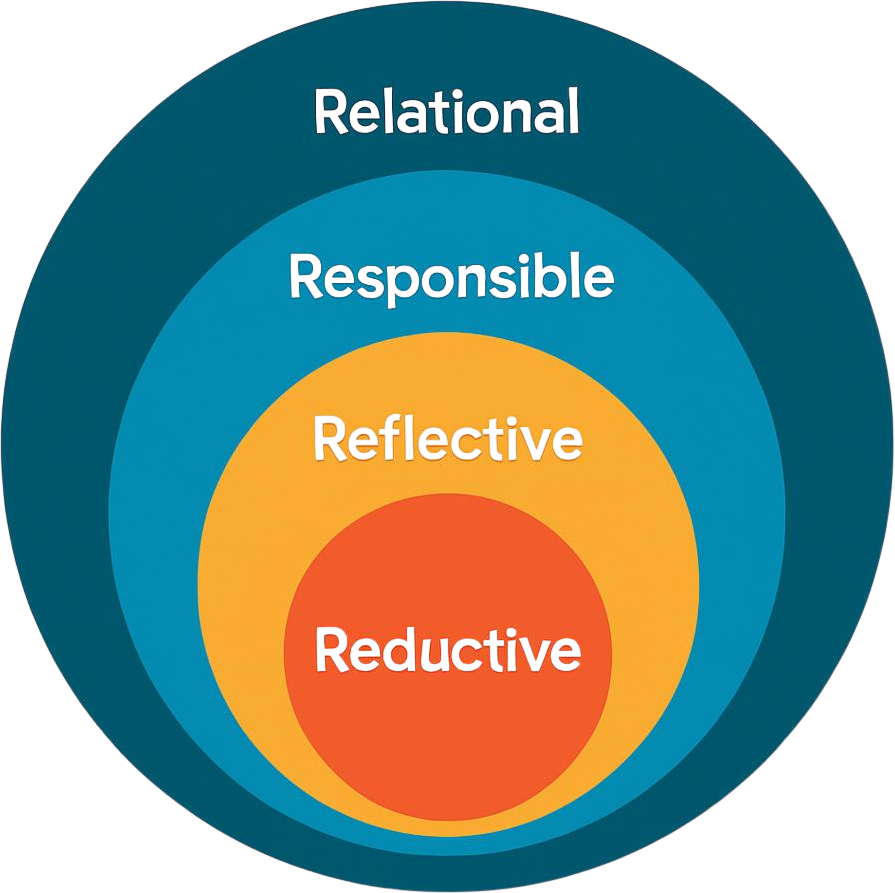
Think of them as nested circles, moving from narrow to broad:
- Reductive: This is the traditional accounting view. Success means increasing earnings. It’s focused on shareholders, measured in financial terms, and looks at short-term results. Most businesses default to this standard, even when they claim to care about other things.
- Reflective: Here we’re thinking about shareholder value creation over the long term. This goes beyond quarterly earnings to consider how the market values the business. It’s still shareholder-focused, but with a longer time horizon.
- Responsible: Now we expand to all stakeholders—not just shareholders, but employees, customers, suppliers, and communities. Success means delivering financial impact across this broader group. The timeframe extends further, and value is measured by stakeholder financial wellbeing.
- Relational: The broadest view considers public wellbeing. Success means enhancing society overall. The timeframe is long-term, and value is measured by stakeholder wellbeing in the fullest sense.
Why This Matters for Marketing
Here’s the thing: marketing’s strategic importance gets lost when we default to the Reductive standard. If you’re only measuring accounting earnings, marketing looks like a cost center. But if you’re thinking about long-term shareholder value (Reflective) or stakeholder impact (Responsible), suddenly marketing’s role in building brands, relationships, and trust becomes central.
It’s also inconsistent to claim marketing benefits multiple stakeholders while only measuring financial market success. You can’t have it both ways.
The Alignment Problem
The real insight is this: there must be alignment between how you define business success, the metrics you use to measure performance, and your conception of marketing’s role.
If your CEO talks about stakeholder capitalism but your bonus structure rewards quarterly earnings, you have a problem. If your mission statement emphasizes social impact but your dashboard only shows profit margins, you’re measuring the wrong things.
Different businesses genuinely have different purposes. A cause-based organization shouldn’t be assessed the same way as a pure profit-maximizer. But right now, we’re trying to force everything through the same narrow lens.
What Should You Do?
First, be explicit about which standard you’re actually operating under. Don’t claim to be Relational when you’re really Reductive—there’s nothing wrong with being clear about your actual goals.
Second, make sure your metrics match your stated purpose. If you say stakeholders matter, measure stakeholder outcomes. If you claim to care about long-term value, stop obsessing over quarterly results.
Third, recognize that marketing’s role changes depending on which standard you adopt. Under Reductive thinking, marketing is tactical. Under Reflective or Responsible standards, it becomes strategic.
The 4Rs framework isn’t about saying one approach is right and others are wrong. It’s about bringing clarity and consistency to how we think about business success. Because right now, we’re measuring everything with the wrong ruler—and wondering why the numbers don’t make sense.
For more on sustainable business and reporting see here Sustainable Corporate Responsibility, Academics Must Do Good Work To Be Relevant, and Managing For Stakeholders
Read: Jonathan Knowles and Neil Bendle (2026) There are 4 R’s in performance: How you measure the performance of business should reflect what you believe constitutes business success, Marketing Strategy Journal, Article In Advance