
Can we become more sustainable as we grow the economy? This hope of ‘green growth’ is appealing but to some it seems too good to be true. As I’m relatively optimistic about our chances of doing better socially and environmentally while also growing the economy it is helpful to read more downbeat views. A paper prepared for the European Environment Bureau, an umbrella group of “environmental citizens’ organisations”, poured cold water on the idea of green growth. Part of the challenge I see is that whether we can succeed depends upon how you define success. I think we will have to be willing to class “better but sadly not perfect” as a win. If anyone has a perfect plan — where everyone is happy, the environment is pristine, and we have shed our desire for unnecessary material goods — that’d be great. I haven’t seen it and I’m much more skeptical of that being found than green growth occurring.
Can We Stop Debunking Stuff?
The report uses a provocative title, Decoupling Debunked. Decoupling is gaining good things, e.g., economic growth, without the bad that often comes with it, e.g., environmental destruction.
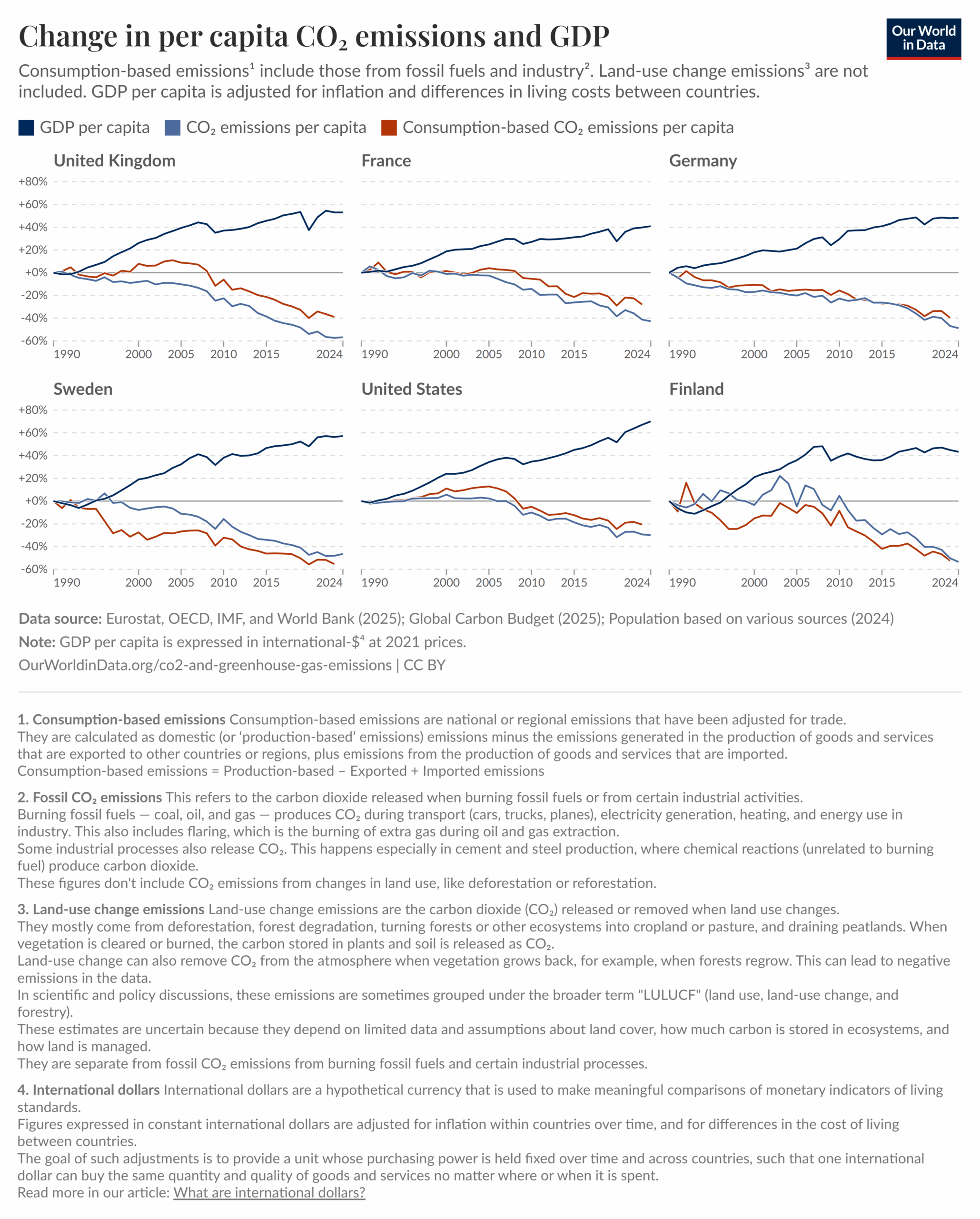
The authors don’t believe in decoupling and the alternative they seem to embrace is some sort of degrowth, economic downscaling. Basically, people in the rich world give agree to reduce our economic activity in the hope of benefiting less wealthy nations and the environment.
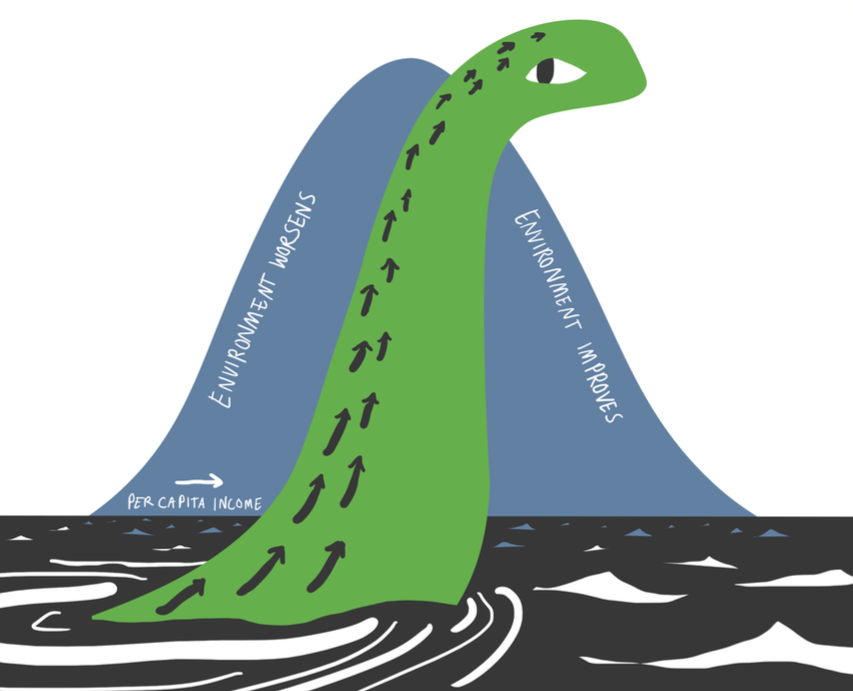
As an aside, the world would probably be a better place if we all collectively forgot the word debunked. Honestly, claiming to debunk something instantly loses credibility in my eyes. Also, at the risk of not focusing on the important bit of the report, the cover is odd — maybe Nessie representing green growth(?) smashing through a hill/curve representing decoupling. It’d be cute for a kids’ book, but I didn’t get why they used it on their serious report.
The Precautionary Principle
[The authors argue for] direct downscaling of economic production in many sectors
Parrique and colleagues, 2019, page 3
and parallel reduction of consumption that together will enable the good life within the planet’s
ecological limits. In the view of the authors of this report and based on the best available scientific
evidence, only such strategies respect the EU’s ‘precautionary principle’, the principle that when
the stakes are high and the outcomes uncertain, one should err on the side of caution.
They cite the EU’s precautionary principle in support of their idea for downscaling. This principle is fascinating from a decision-making perspective. The gist seems reasonable at first glance, don’t take an action that could lead to disaster even if the probability of disaster is small. Unfortunately, when you press further it leaves vague how big a disaster and how big a probability. Surely, we have to do something? We can’t just avoid all action in case something bad happens.
The principle scares me a little because it seems exactly the same as Dick Cheney’s 1% doctrine. This was Cheney’s justification for dramatic military action in Iraq even if the evidence to support his position was weak. To Cheney’s mind the US would be justified in self-defense to invade a country that was thought to be a potential threat even if the threat was very, very low. It is easy to see how this sort of vague thinking can spiral quickly. Donald Trump’s 2026 Iran war that we are currently witnessing seems to use the same precautionary principle.
In the realm of sustainability, the precautionary principle might be interpreted as arguing for banning nuclear power to prevent the (very small but serious) threat a meltdown poses. If the precautionary principle means we end up using more coal, surely more people will die from mining, air pollution, and climate change. That doesn’t work for me, at least without a major discussion. We can’t just follow a general principle.
Can We Decouple?
A challenge with any paper is that things change and published papers don’t. A lot of the discussion seemed old through no fault of the authors, it was published in 2019. The authors review academic papers, which often take years to publish, so we get lots of views from the early 2000s. Interesting, but losing relevance now that renewables are massively overperforming expectations.
I wasn’t totally sure how the papers were chosen which is more of a problem. Paper selection can make a big difference to the conclusion one draws. It shouldn’t be surprising to anyone that marketing papers tend to highlight the benefits of marketing. Similarly, I’d expect journals sympathetic to degrowth ideas tend to publish papers that support degrowth ideas. As such, authors are able to find papers that support their views, but this was not the entire universe of papers even back in 2019. What papers did they include, which did they omit, and why?
Better But Sadly Not Perfect
A lot of the challenge comes down to what do we expect to achieve. I’m optimistic that we can make environmental and social progress while still having a stronger economy. (Arguments that GDP is a bad measure seem very reasonable so I’m not saying GDP should be the measure used of a stronger economy). That said, I’m not convinced we will get to an ideal world in my lifetime. I think better but sadly not perfect is the only reasonable hope.
The authors seem to have a higher standard that I’m not sure any plan could meet. For example, they want evidence that any decoupling is permanent. We can’t really ever show that nothing will go wrong in the future. To my mind we are in a situation that needs to be dealt with now. I’m great with the idea that we can make progress now without being absolutely sure it is permanent. Don’t take actions you know will come back to kill everyone in 200 years but do prioritize sorting out today’s problems today even if this leaves some challenges for future generations to deal with.
Infinite Growth Isn’t Possible. Sure, okay
The degrowth people often talk of the impossibility of infinite growth on a finite planet. Hard to argue with that statement. It is clearly theoretically true. Still, when the constraints will actually bite really matters. If we come up with a solution for the next hundred years that makes the world fairer, richer, and more environmentally secure I’d be relatively happy. Maybe the benefits of our plan will tail off eventually. Okay. Spotting the next century’s problem and working on it is great, but let’s not ignore the “temporary 100-year solution” because we don’t have a complete plan for what happens next. People are clever, we can work on it over the next 100 years and hopefully find another solution (even if another temporary one).
We don’t need to solve the problem of infinite growth on a finite planet today. Let’s solve what we can now before we move onto the problems of infinity.
For more on degrowth An Ineffective Defense Of Degrowth, Limits And Self-Limits, Are We Making Any Progress On Sustainability?, Working In the Doughnut, Messaging About Sustainability, Sustainability And Grand Historical Sweeps, and Modern Business And Sustainability
Read: Parrique T., Barth J., Briens F., C. Kerschner, Kraus-Polk A., Kuokkanen A., and Spangenberg J.H. (2019) Decoupling debunked – Evidence and arguments against green growth as a sole strategy for sustainability, European Environment Bureau, https://eeb.org/wp-content/uploads/2019/07/Decoupling-Debunked.pdf