
The Stern Report (2006) was a milestone in the UK’s action against climate change. Commissioned by the Labour government at the time they, and their immediate Conservative successors, took much of report’s advice to fight climate change. And they gave the economist author a peerage — he is now Lord Stern — but that is a pretty silly way to address anyone. (Sorry to my friends in the House of Lords). Stern has recently done a second follow up report with more advice on how we can fight climate change. His main message is a positive one: growth can come from climate action.
Growth Can Come From Climate Action
We can now see that climate action is a driver of growth in the short, medium, and longer term.
Stern, 2025, page 200
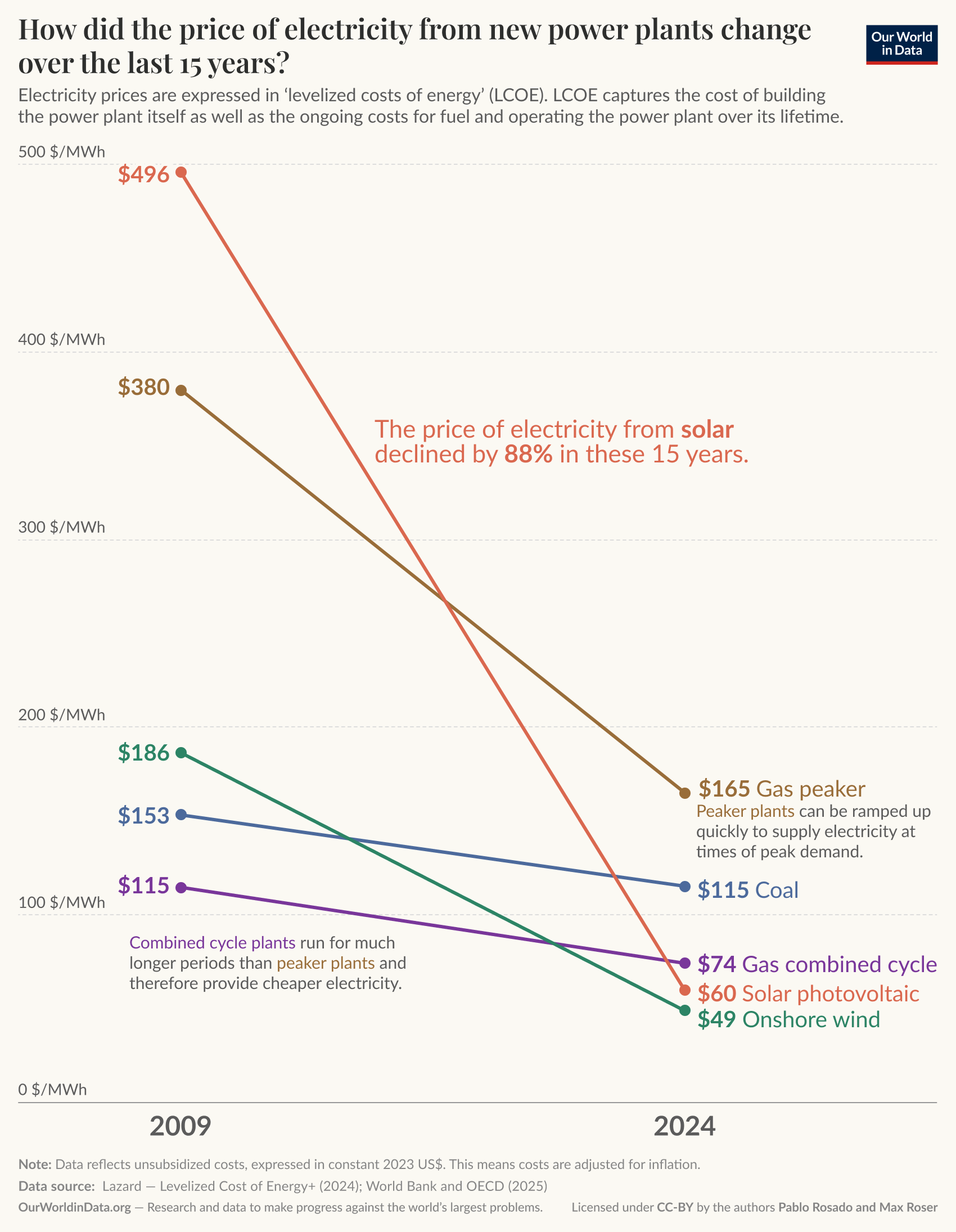
Stern is bullish that growth that can come from climate action. He outlines a variety of reasons for thinking this. These include how climate action can solve market failures that are holding back the economy. Other reasons include that people will be healthier if we take climate action; and healthy people drive the economy forward. Plus, we are only starting to learn about many climate friendly technologies. We have got a lot better at making solar panels and are still learning new things every year. There isn’t the same potential to get better at burning coal. We have had a couple of hundred years of practice; pretty much anything that we could learn about burning coal we already have.
While there have been (and are still) challenges getting the economic benefits from the transition to renewables, falls in the cost of energy should help drive growth across the entire economy. (As I write this, oil and gas prices are rising thanks to Donald Trump’s war in Iran which is only additional impetus to faster adoption of renewable energy). After all, energy is vital to pretty much everything. Improvements in clean energy production hold out the hope of economic growth while fighting climate change.
Growth Or Degrowth
Stern’s robust view that growth can come from climate action puts him in conflict with a (cool kid) view that we can only address climate by degrowth. This (often fuzzy) concept generally means reining back our economy. Perhaps it exists but I’m yet to find a convincing argument for degrowth as theoretically desirable or a practically deliverable. Stern isn’t mincing his words about the ideas of the degrowth movement.
We know that there are many ways to alter our consumption and production patterns to reduce emissions, so the idea that reducing consumption is a necessary condition for reducing emissions makes little sense. Similarly, no one suggests, I hope, that we should achieve net zero by reducing the population to zero.
Stern, 2025, page 342
Stern is dismissive of the idea that because in the past economic growth drove the problem of climate change, we must abandon economic growth. (To be clear Stern’s conception of economic growth isn’t just a crude belief that higher GDP always good).
It is true that the new route will be very different from the past, but to argue that it is impossible because it has not been done before is simply illogical.
Stern ,2025, page 629
A Hopeful View Of The Future
Stern’s book contains a wealth of information. I’m not going to pretend it is a fun read. It is a bit like eating broccoli. It is good for you, but you have a massive sigh of relief when it is over. Still, it is refreshing to see a cogent argument made that we can create a stronger economy which helps people get out of poverty without destroying the environment. What is more, the economy needs environmental protection. Is helpful that an economist makes the important point that destroying the environment will, obviously, wreck the economy.
For more on degrowth see An Ineffective Defense Of Degrowth, Limits And Self-Limits, Messaging About Sustainability, Sustainability And Grand Historical Sweeps, and Modern Business And Sustainability
Read: Nicholas Stern (2025) The Growth Story of the 21st Century: The Economics and Opportunity of Climate Action, LSE Press